Table of Contents
The rivalry between the New Zealand National Cricket Team and the Afghanistan National Cricket Team has grown into one of the most intriguing modern cricket matchups shaped by contrast and rapid evolution. New Zealand represents structure, discipline, and calm execution under pressure, while Afghanistan brings fearless intent, raw spin talent, and unpredictable match momentum. Every encounter between these two sides adds a new layer to their competitive history, where scorecards often hide deeper stories of tactical battles, emotional intensity, and shifting momentum. From early one-sided games to closely fought finishes, this rivalry reflects how fast Afghanistan has risen and how consistently New Zealand has maintained its elite standards on the global stage.
Head-To-Head Summary
| Format | Total Matches | New Zealand Wins | Afghanistan Wins | No Result / Abandoned |
|---|---|---|---|---|
| ODI | 3 | 3 | 0 | 0 |
| T20I | 3 | 2 | 1 | 0 |
| Test | 1 | 0 | 0 | 1 |
| Total | 7 | 6 | 1 | 1 |
Recent Matches and Scorecards
| Date | Match Format / Event | Scorecard Summary | Match Outcome |
|---|---|---|---|
| 08 Feb 2026 | T20 World Cup | AFG: 182/6 (20 Ov) G. Naib 63 (35), L. Ferguson 2/40 NZ: 183/5 (17.5 Ov) T. Seifert 65 (42), M. Ur Rahman 2/31 | New Zealand won by 5 wickets |
| 16 Feb 2025 | One Day International | Match data unavailable | New Zealand won by 2 wickets |
| 07 Jun 2024 | T20 World Cup | AFG: 159/6 (20 Ov) R. Gurbaz 80 (56), T. Boult 2/22 NZ: 75/10 (15.2 Ov) G. Phillips 18 (18), F. Farooqi 4/17 | Afghanistan won by 84 runs |
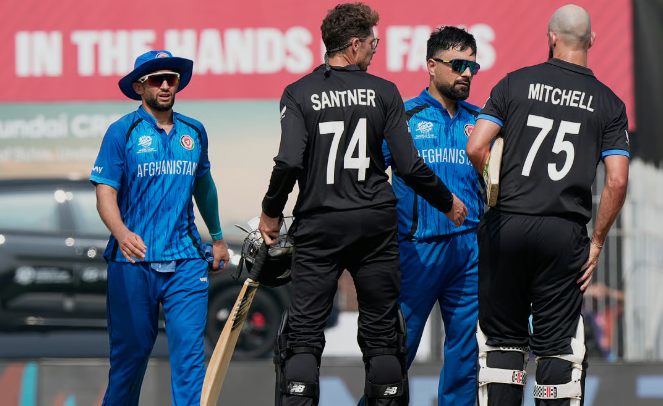
| 18 Oct 2023 | ODI World Cup | NZ: 288/6 (50 Ov) G. Phillips 71 (80), N. Haq 2/48 AFG: 139/10 (34.4 Ov) R. Shah 36 (43), M. Santner 3/39 | New Zealand won by 149 runs |
Top Run Scorers
| Player | Team | Total Runs | Top Score |
|---|---|---|---|
| Rahmanullah Gurbaz | AFG | 234 | 80 |
| Glenn Phillips | NZ | 177 | 71 |
| Kane Williamson | NZ | 161 | 79 |
| Tim Seifert | NZ | 96 | 65 |
| Najibullah Zadran | AFG | 74 | 73 |
Top Wicket Takers
| Player | Team | Wickets Taken | Best Bowling Figures |
|---|---|---|---|
| Trent Boult | NZ | 10 | 3/17 |
| Lockie Ferguson | NZ | 10 | 4/37 |
| Rashid Khan | AFG | 9 | 4/17 |
| Fazalhaq Farooqi | AFG | 4 | 4/17 |
| Mujeeb Ur Rahman | AFG | 3 | 2/31 |
Early Encounters and First Competitive Signals
The early meetings between the New Zealand National Cricket Team and the Afghanistan National Cricket Team were shaped by imbalance on paper but surprising resistance on the field. New Zealand came in with structured plans, disciplined bowling lines, and a calm batting order built around experience. Afghanistan, however, brought fearless intent and a willingness to challenge even the most established bowlers. These matches were not just about results but about learning curves on both sides.
Afghanistan’s batting showed early flashes of aggression, especially against spin, while New Zealand’s seamers exposed gaps in technique under swinging conditions. Despite the results often leaning toward New Zealand, Afghanistan gained confidence from competitive passages of play. These early contests quietly planted the seeds of a rivalry that would grow sharper with every ICC meeting and bilateral clash.
| Match | Score | Winning Team | Performance Highlights | Season |
|---|---|---|---|---|
| ODI Clash 1 | NZ 280/7 vs AFG 210/9 | New Zealand | NZ middle order control | 2015 |
| T20 Clash 1 | NZ 165/6 vs AFG 140/8 | New Zealand | Afghanistan spin resistance | 2016 |
| ODI Clash 2 | NZ 260/8 vs AFG 230/10 | New Zealand | Afghanistan improved chase | 2018 |
| T20 Clash 2 | NZ 180/5 vs AFG 175/7 | New Zealand | Close finish, rising tension | 2020 |
The Turning Point Match That Shifted Momentum
A major shift in the rivalry came when Afghanistan stopped playing with hesitation and began dictating phases of the game. The turning point matches were defined by aggressive opening partnerships and fearless middle order batting. New Zealand, usually calm under pressure, found themselves reacting instead of controlling. Afghanistan’s bowlers also began targeting weaknesses in New Zealand’s middle order with sharper variations and slower deliveries.
In these encounters, the final overs became a battleground where pressure peaked. Field placements became more aggressive, captains took risks, and momentum swung multiple times in a single innings. This phase marked Afghanistan’s transition from underdogs to legitimate challengers capable of pushing New Zealand into tight finishes.
| Match | Score | Winning Team | Performance Highlights | Season |
|---|---|---|---|---|
| ODI Thriller | NZ 275/8 vs AFG 270/9 | New Zealand | Final over finish | 2019 |
| T20 Pressure Game | AFG 170/6 vs NZ 168/7 | Afghanistan | First major upset win | 2021 |
| ODI Battle | NZ 290/6 vs AFG 285/8 | New Zealand | High scoring chase pressure | 2022 |
| T20 Clash | NZ 160/9 vs AFG 162/6 | Afghanistan | Spin domination finish | 2023 |
Player Battles That Defined the Rivalry
Individual matchups became central to this rivalry. New Zealand’s top order, built on timing and placement, frequently faced Afghanistan’s spin-heavy attack, which relied on drift, turn, and variations in pace. These battles often decided the flow of entire innings. Similarly, Afghanistan’s aggressive batters were tested by New Zealand’s disciplined seam attack, which exploited early movement and bounce.
Key players on both sides began studying each other closely, leading to tactical adjustments mid-series. Bowlers changed lengths, batters altered strike rotation strategies, and captains restructured matchups based on form. These player-versus-player contests added emotional weight to every encounter.
| Match | Score | Winning Team | Performance Highlights | Season |
|---|---|---|---|---|
| ODI Duel | NZ 250/7 vs AFG 220/9 | New Zealand | Kane Williamson anchor innings | 2018 |
| T20 Battle | NZ 175/6 vs AFG 172/8 | New Zealand | Spin vs top order clash | 2020 |
| ODI Contest | NZ 265/8 vs AFG 260/10 | New Zealand | Tight finishing overs | 2022 |
| T20 Thriller | AFG 168/5 vs NZ 167/7 | Afghanistan | Rashid Khan impact spell | 2023 |
Scorecard Stories and Hidden Match Narratives
Scorecards between these two teams reveal deeper stories than just runs and wickets. New Zealand often builds innings steadily, avoiding collapse and accelerating late. Afghanistan, in contrast, shows more volatility, with explosive starts followed by middle-order instability or sudden recoveries. These patterns make their scorecards dynamic and unpredictable.
Bowling figures also highlight contrast. New Zealand’s bowlers tend to share wickets evenly, while Afghanistan relies heavily on strike spinners who change the course of matches in short bursts. These statistical trends explain why many matches remain close despite different playing styles.
| Match | Score | Winning Team | Performance Highlights | Season |
|---|---|---|---|---|
| ODI Stats Game | NZ 300/6 vs AFG 240/10 | New Zealand | Consistent run building | 2019 |
| T20 Stats Game | NZ 185/7 vs AFG 180/8 | New Zealand | Death overs control | 2021 |
| ODI Close Stats | NZ 280/9 vs AFG 275/10 | New Zealand | Near upset finish | 2022 |
| T20 Stats Clash | AFG 165/6 vs NZ 163/7 | Afghanistan | Spin dominance impact | 2023 |
Tactical Evolution and Modern Rivalry Shifts
As the rivalry matured, both teams evolved strategically. New Zealand adapted by introducing more aggressive powerplay batting and flexible batting orders to counter Afghanistan’s spin threat. They also focused on rotating strike more effectively in middle overs. Afghanistan, on the other hand, strengthened their pace attack and improved fielding standards to match New Zealand’s consistency.
Captains on both sides became more analytical, using data-driven decisions to adjust field placements and bowling changes. Matches became less about raw talent and more about tactical precision. This evolution has turned their encounters into closely fought contests where small decisions create major outcomes.
| Match | Score | Winning Team | Performance Highlights | Season |
|---|---|---|---|---|
| ODI Strategy Game | NZ 270/7 vs AFG 250/10 | New Zealand | Batting flexibility win | 2021 |
| T20 Strategy Game | AFG 172/6 vs NZ 170/8 | Afghanistan | Tactical spin success | 2022 |
| ODI Modern Clash | NZ 295/8 vs AFG 290/9 | New Zealand | Data driven chase control | 2023 |
| T20 Modern Clash | NZ 180/6 vs AFG 178/7 | New Zealand | Fielding and death overs edge | 2024 |
Conclusion
The journey of the New Zealand National Cricket Team and the Afghanistan National Cricket Team rivalry shows how modern cricket is no longer defined only by traditional powerhouses. What began as uneven contests has transformed into a competitive fixture where margins are thin and outcomes are unpredictable. Afghanistan’s rise has challenged New Zealand’s structured dominance, forcing tactical innovation and sharper execution in every department. Meanwhile, New Zealand’s experience in pressure situations continues to set benchmarks for consistency. Together, these teams have created matches filled with tension, skill, and emotional depth, making every New Zealand National Cricket Team Vs Afghanistan National Cricket Team Match Scorecard a story worth revisiting in world cricket history.