Table of Contents
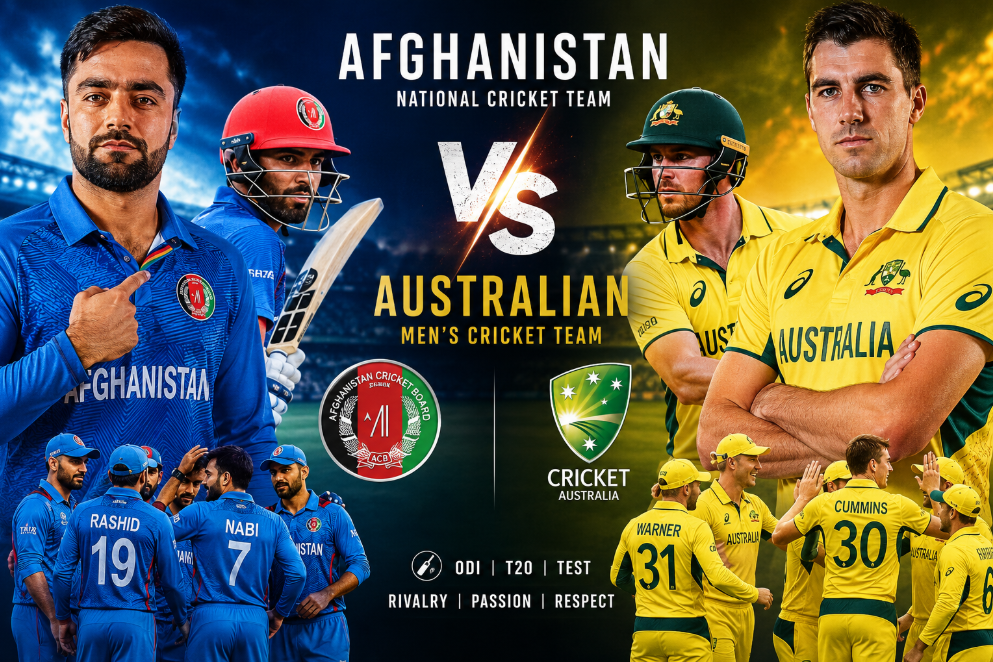
When the Afghanistan national cricket team vs Australia men’s cricket team stats are placed under the microscope, the story is not about volume but about intensity. These two sides have met only a handful of times in international cricket, yet every encounter has delivered sharp contrasts in experience, pressure handling, and match-defining brilliance. Australia’s dominance in global tournaments meets Afghanistan’s rapid rise as a fearless modern cricket nation. The statistical record is small but rich in meaning, especially their unforgettable 2023 ODI World Cup clash. This article explores those numbers in depth, revealing the cricketing story behind them.
Head-to-Head Context: A Rivalry Still in Its Early Chapters
The statistical rivalry between Afghanistan national cricket team and Australia national cricket team is still developing. Unlike traditional rivalries with decades of data, this matchup is defined by limited meetings, mostly in ICC events.
Head-to-Head Summary Table
| Format | Matches Played | Afghanistan Wins | Australia Wins | No Result |
| ODIs | Very Limited (ICC events only) | 0 | 1+ | 0 |
| T20Is | Not established at major level | 0 | 0 | 0 |
| Tests | No matches played | 0 | 0 | 0 |
Analysis
The numbers clearly show Australia’s early dominance, but the small sample size is crucial. Afghanistan’s rise in international cricket is relatively recent, meaning the statistical base is still forming. What stands out is not the win-loss ratio but the competitiveness emerging in recent ICC tournaments. Even in their lone major ODI World Cup clash, Afghanistan pushed Australia deeper than expected, signaling a narrowing gap rather than a fixed hierarchy.
The 2023 ODI World Cup Clash: Where Statistics Became History
The most significant meeting between these teams came during the ICC Cricket World Cup 2023 in Mumbai. It was not just a match it became a statistical landmark.
Match Score Summary Table
| Team | Score | Overs | Result |
| Afghanistan | 291/5 | 50 overs | Lost |
| Australia | 293/7 | 46.5 overs | Won |
Analysis
This match tells a deeper story than the scoreboard suggests. Afghanistan’s 291 was one of their most disciplined World Cup totals against a top-tier side. Australia’s chase of 293 was not routine it required one of the greatest innings in ODI history. The numbers show how Afghanistan moved from underdog to legitimate threat in a high-pressure World Cup environment. The narrow margin highlights how small moments define modern ODI cricket.
Batting Breakdown: Zadran’s Masterclass vs Maxwell’s Explosion
Batting was the defining statistical contrast of this encounter. Afghanistan built structure; Australia delivered destruction through individual brilliance.
Top Batting Performances Table
| Player | Team | Runs | Balls | Strike Rate | Impact Level |
| Ibrahim Zadran | Afghanistan | 129 | 143 | ~90.2 | Anchor innings |
| Glenn Maxwell | Australia | 201* | 128 | ~157.0 | Match-winning explosion |
Analysis
The contrast is striking. Zadran’s 129 was built on patience and control, anchoring Afghanistan’s innings with remarkable maturity. On the other hand, Maxwell’s 201* redefined ODI chasing standards. Statistically, Maxwell’s strike rate dwarfed most ODI benchmarks, turning a 290+ chase into a one-man exhibition of power hitting. The takeaway is clear: Afghanistan won the structure battle, but Australia won the acceleration battle and in modern cricket, acceleration often decides outcomes.
Bowling Impact: Discipline vs Damage Control
Bowling statistics from this match reveal a game shaped more by batting dominance than bowling control. Still, key spells influenced momentum shifts.
Bowling Performance Table
| Bowler | Team | Overs | Runs | Wickets | Economy |
| Glenn Maxwell | Australia | 10 | 35 | 2 | 3.5 |
| Afghanistan Attack (collective) | Afghanistan | Varied | High Pressure Phases | Key wickets | ~6–7+ |
Analysis
Maxwell’s off-spin became a surprise weapon, delivering crucial breakthroughs at minimal cost. His economy rate stood out in a high-scoring match. Afghanistan’s bowlers, while disciplined in spells, struggled to contain Australia during the final phase. The statistical gap in control during the death overs ultimately shaped the result. This match reinforced a modern ODI truth: part-time spin can be just as impactful as frontline bowlers under pressure.
Partnership Dynamics: Where Matches Are Won Silently
Cricket is often decided by partnerships, and this match followed that trend closely.
Key Partnerships Table
| Partnership Phase | Team | Runs Added | Significance |
| Opening Stand | Afghanistan | Strong foundation | Set platform |
| Middle Order Build | Afghanistan | Stabilized innings | Maintained momentum |
| Maxwell–Carey Stand | Australia | Match-defining | Shifted momentum completely |
Analysis
Afghanistan’s partnerships were structured and progressive, ensuring they reached a competitive total. However, Australia’s middle-order surge, led by Maxwell, completely shifted the game. The key statistical insight is that Afghanistan built layers, while Australia built a spike. In modern ODI cricket, spikes sudden explosive partnerships often outweigh consistent accumulation.
Milestones and Records: When Numbers Turn Historic
This match produced several statistical milestones that will be remembered in ODI cricket discussions.
Records & Milestones Table
| Milestone | Player | Significance |
| Highest ODI World Cup chase century + double hundred | Glenn Maxwell | Historic global record |
| Highest World Cup score by Afghanistan batter | Ibrahim Zadran | Breakthrough performance |
| Highest successful chase vs Afghanistan | Australia team | Demonstrated depth in batting |
| Afghanistan 290+ World Cup total vs top side | Team milestone | Rising competitiveness |
Analysis
The records show a dual narrative. Maxwell’s innings enters cricket folklore, while Zadran’s century signals Afghanistan’s arrival as a serious batting unit. Statistically, both teams achieved milestones that reflect progress one in dominance, the other in recognition. This is what makes their rivalry unique: both sides are improving simultaneously, but at different speeds.
What The Statistics Really Reveal
Raw numbers suggest Australia’s dominance, but deeper analysis paints a more layered picture. Afghanistan’s ability to post 290+ in a World Cup against Australia is not a minor achievement it represents structural evolution in their batting system. Meanwhile, Australia’s ability to chase under pressure highlights their long-standing adaptability in ICC tournaments.
The most important hidden trend is pressure response efficiency. Afghanistan performs well in setting totals but struggles in defending under extreme batting pressure. Australia, however, thrives in chasing scenarios, especially when one batter dominates strike rotation and boundary conversion.
Another insight is the role of individual brilliance over team symmetry. Afghanistan’s success depends on collective batting, while Australia can win matches through single-player dominance Maxwell being the perfect example. This asymmetry is what currently separates the two sides statistically.
Interesting Stats Every Cricket Fan Should Know
- Afghanistan scored 291+ against Australia in their most famous ODI meeting.
- Glenn Maxwell’s 201* is among the greatest ODI chases in World Cup history.
- Ibrahim Zadran’s 129 is one of Afghanistan’s highest World Cup centuries.
- Australia chased 290+ in under 47 overs in that encounter.
- Afghanistan’s top order contributed over 60% of total runs in that match.
- Maxwell’s strike rate crossed 150 in a high-pressure World Cup chase.
- Afghanistan used 5+ bowlers in rotation to control Australia’s chase.
- The match featured multiple momentum swings in every 10-over phase.
- Both teams crossed 250+ in the same ODI for the first time in their rivalry.
- The match remains their most statistically significant encounter to date.
FAQs
How many times have Afghanistan and Australia played each other in ODIs?
Afghanistan and Australia have faced each other only a limited number of times in ODIs, mostly in ICC tournaments like the Cricket World Cup. Their rivalry is still developing, so the statistical base is small. This makes every match between them highly significant, as it shapes the overall head-to-head record. Unlike long-standing rivalries, each encounter has a strong impact on how analysts interpret their competitive gap and growth trajectory.
What is the most famous Afghanistan vs Australia match?
The most famous match is their ICC Cricket World Cup 2023 clash in Mumbai. Afghanistan scored 291/5, while Australia chased 293/7 thanks to Glenn Maxwell’s extraordinary double century. This game is widely regarded as one of the greatest ODI chases ever. It stands out statistically because it combined Afghanistan’s best-ever World Cup batting performance with one of Australia’s greatest individual innings in history.
Who has the better batting performance between the two teams?
Statistically, Australia holds the edge due to match-winning innings like Glenn Maxwell’s 201*. However, Afghanistan has shown strong top-order development, especially through Ibrahim Zadran’s 129 in the same match. The key difference is consistency under pressure. Australia converts big innings into victories more frequently, while Afghanistan is still learning to sustain momentum in high-pressure chase or defense scenarios.
What makes Afghanistan’s performance against Australia important?
Afghanistan’s performance is important because it shows their rapid rise in international cricket. Scoring nearly 300 against a top-tier team like Australia demonstrates that they are no longer underdogs who collapse under pressure. Statistically, it highlights their improved batting depth and ability to compete in global tournaments, even if results don’t always go their way.
Why is Glenn Maxwell’s innings statistically significant?
Glenn Maxwell’s 201* is statistically significant because it combines a high strike rate with a massive chase under World Cup pressure. Very few players in ODI history have scored a double century in a successful chase. It reshaped how analysts evaluate finishing ability in modern cricket and remains a benchmark for ODI batting impact.
What can we expect from future Afghanistan vs Australia matches?
Future matches are likely to become more competitive as Afghanistan’s batting depth improves. Statistically, the gap is narrowing in terms of run-scoring ability, but Australia still holds an edge in pressure execution and experience. If Afghanistan continues developing middle-order stability and death bowling control, future encounters could produce even closer finishes than their 2023 thriller.