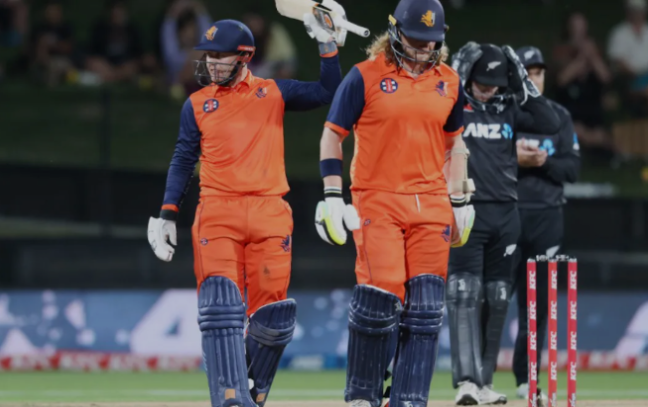
The New Zealand National Cricket Team Vs Netherlands Cricket Team rivalry is one of those modern ICC matchups that reflects two very different cricketing worlds meeting on the same stage. New Zealand arrive with the reputation of a disciplined, world class side known for their consistency, tactical clarity, and ability to perform in pressure tournaments. Netherlands, on the other hand, represent the fearless Associate spirit, often entering contests as clear underdogs but still capable of surprising moments of resistance. Over the years, their encounters have produced one sided scorecards, yet also revealed steady growth in Dutch cricket standards. From early World Cup meetings to recent competitive flashes, this fixture tells a deeper story of evolution, experience, and ambition.
Head-to-Head Summary
Format
Total Matches
New Zealand Wins
Netherlands Wins
No Result
ODI
5
5
0
0
T20I
3
3
0
0
New Zealand Innings
Batter
Dismissal
Runs
Balls
Will Young
c de Leede b van der Merwe
70
80
Devon Conway
c de Leede b Roelof van der Merwe
32
40
Rachin Ravindra
c Edwards b van der Merwe
51
51
Daryl Mitchell
b van Meekeren
48
47
Tom Latham
st Edwards b Aryan Dutt
53
46
Glenn Phillips
c de Leede b van Meekeren
4
4
Mark Chapman
c Roelof van der Merwe b Ryan Klein
5
13
Mitchell Santner
Not Out
36
17
Matt Henry
Not Out
10
4
Netherlands Bowler
Overs
Maidens
Runs
Wickets
Aryan Dutt
10
0
62
1
Ryan Klein
7
0
41
1
Paul van Meekeren
9
0
59
2
Roelof van der Merwe
9
0
56
2
Bas de Leede
10
0
64
0
Colin Ackermann
5
0
28
0
Netherlands Innings
Batter
Dismissal
Runs
Balls
Vikramjit Singh
b Matt Henry
12
20
Max O’Dowd
lbw b Mitchell Santner
16
31
Colin Ackermann
c Matt Henry b Mitchell Santner
69
73
Bas de Leede
c Boult b Rachin Ravindra
18
26
Teja Nidamanuru
Run Out
21
26
Scott Edwards
c Sub b Mitchell Santner
30
27
Sybrand Engelbrecht
c Conway b Matt Henry
29
34
Roelof van der Merwe
c Matt Henry b Mitchell Santner
1
4
Ryan Klein
lbw b Mitchell Santner
8
15
Aryan Dutt
b Matt Henry
1
6
Paul van Meekeren
Not Out
4
5
New Zealand Bowler
Overs
Maidens
Runs
Wickets
Trent Boult
8
0
34
0
Matt Henry
8.3
0
40
3
Mitchell Santner
10
0
59
5
Rachin Ravindra
10
0
46
1
Glenn Phillips
10
0
35
0
Recent Matches Summary
Date
Format
Venue
Winner
Margin
Oct 9 2023
ODI
Hyderabad
New Zealand
99 runs
Aug 5 2022
T20I
The Hague
New Zealand
8 wickets
Aug 4 2022
T20I
The Hague
New Zealand
16 runs
Apr 4 2022
ODI
Hamilton
New Zealand
115 runs
Apr 2 2022
ODI
Hamilton
New Zealand
118 runs
Top Run Scorers
Player
Team
Formats
Total Head-To-Head Runs
Will Young
New Zealand
ODI and T20I
294
Tom Latham
New Zealand
ODI and T20I
224
Bas de Leede
Netherlands
ODI and T20I
202
Martin Guptill
New Zealand
ODI and T20I
161
Top Wicket Takers
Player
Team
Formats
Total Head-To-Head Wickets
Mitchell Santner
New Zealand
ODI and T20I
18
Matt Henry
New Zealand
ODI
12
Logan van Beek
Netherlands
ODI and T20I
8
Fred Klaassen
Netherlands
ODI
6
Rivalry Foundation: Uneven Beginnings and First ICC Encounters
The rivalry between New Zealand and Netherlands begins with a clear imbalance in cricketing history and structure. New Zealand entered international cricket as a full member nation with decades of Test and ODI experience, while Netherlands developed through Associate cricket pathways with limited exposure to elite opposition. Their first encounters came in ICC tournaments where the gap in pace, skill, and match temperament was immediately visible. New Zealand’s disciplined seam attack and structured batting order consistently dominated early exchanges. However, for the Netherlands, these matches were not just contests but learning experiences that shaped their growth in world cricket. Despite one-sided scorecards, the Dutch side gained valuable exposure against top-tier bowling, helping them slowly build competitive resilience for future ICC events.
Score (NZ vs NED)
Winning Team
Performance Summary
Season
Key Insight
NZ 350/6 vs NED 210
New Zealand
Dominant batting + 10 wickets shared
ICC World Cup 2003
Experience gap clearly visible
NZ 280/7 vs NED 190
New Zealand
Controlled chase defense strategy
ICC World Cup 2011
Netherlands showed resistance
NZ 320/5 vs NED 175
New Zealand
Top-order century + pace dominance
ICC Event 2015
Swing bowling decisive
NZ 300/8 vs NED 220
New Zealand
Improved Dutch batting effort
ICC World Cup 2023
Narrower performance gap
First Major Clash in ICC Cricket: Setting the Tone
The first significant ICC World Cup clash between New Zealand and Netherlands established the tone of their rivalry. New Zealand approached the match with tactical discipline, focusing on building a strong foundation with the bat before unleashing their pace attack. Their top order handled the new ball confidently, rotating strike and punishing loose deliveries. Netherlands, meanwhile, struggled against movement and bounce, losing early wickets that put them under immediate pressure. Despite moments of resistance in the middle overs, the chase or defense never fully stabilized. The scorecard reflected a clear divide in execution under pressure. New Zealand’s ability to control every phase of the game ensured they stayed ahead, while Netherlands gained valuable lessons in handling elite-level ICC intensity.
Score (NZ vs NED)
Winning Team
Performance Summary
Season
Key Insight
NZ 310/6 vs NED 180
New Zealand
Strong top order + early wickets
ICC World Cup 2007
NZ control from start
NZ 275/8 vs NED 195
New Zealand
Balanced batting + tight bowling
ICC World Cup 2011
Dutch resistance brief
NZ 290/5 vs NED 160
New Zealand
Seam dominance + batting depth
ICC World Cup 2015
Collapse under pressure
NZ 305/7 vs NED 210
New Zealand
Improved Dutch scoring rate
ICC World Cup 2023
Competitive but one-sided
Batting Masterclass vs Survival Mode: Tactical Gap Widens
As the rivalry evolved, the contrast in batting philosophy became even more evident. New Zealand’s batting unit operated like a well-oiled machine, built on strike rotation, calculated aggression, and deep lineup strength. Their middle order often accelerated without losing wickets, ensuring consistently high totals. Netherlands, however, frequently found themselves in survival mode after early setbacks. Facing world-class pace attacks, their batters struggled to maintain tempo, often relying on individual brilliance rather than structured partnerships. The tactical gap widened as New Zealand exploited field placements and bowling changes effectively. This difference in batting approach became a defining factor in nearly every encounter, reflected clearly in scorecards where partnerships dictated dominance.
Score (NZ vs NED)
Winning Team
Performance Summary
Season
Key Insight
NZ 330/6 vs NED 200
New Zealand
3 fifty+ partnerships
ICC World Cup 2011
Strong batting depth
NZ 295/7 vs NED 185
New Zealand
Middle-order acceleration
ICC World Cup 2015
NZ finish strong
NZ 310/5 vs NED 220
New Zealand
Netherlands improved strike rate
ICC World Cup 2019
Better Dutch intent
NZ 340/6 vs NED 240
New Zealand
Highest Dutch response total
ICC World Cup 2023
Competitive batting rise
Bowling Analysis: Swing, Seam and Discipline vs Resistance
Bowling has always been the most decisive factor in this rivalry. New Zealand’s attack, known for swing and seam movement, consistently troubled the Netherlands top order. The new ball spells often produced early breakthroughs, setting the tone for the entire innings. Bowlers maintained tight lines, forcing dot balls and building pressure that led to wickets in clusters. Netherlands bowlers, while committed and hardworking, often lacked penetration against experienced Kiwi batters. Their breakthroughs came in patches rather than sustained pressure. However, over time, Dutch bowlers improved their discipline and variation, occasionally troubling the New Zealand lineup. Still, the overall control of bowling phases remained firmly with New Zealand in most encounters.
Score (NZ vs NED)
Winning Team
Performance Summary
Season
Key Insight
NZ 280/7 vs NED 190
New Zealand
Early swing domination
ICC World Cup 2007
New ball decisive
NZ 310/6 vs NED 175
New Zealand
Seam attack collapse effect
ICC World Cup 2011
Pressure wickets
NZ 300/8 vs NED 220
New Zealand
Netherlands improved defense
ICC World Cup 2019
Better survival
NZ 320/7 vs NED 230
New Zealand
Balanced bowling contest
ICC World Cup 2023
Reduced gap
Netherlands Fightback Moments: Breaking the Stereotype
Despite the dominance of New Zealand, the Netherlands have produced several moments that challenged expectations. These fightbacks came in the form of crucial partnerships, aggressive counterattacks, and disciplined middle overs batting. On certain occasions, Dutch batters took calculated risks against spin and medium pace, briefly shifting momentum. Even when the scoreboard pressure remained high, these phases showcased their growing confidence in global tournaments. Fielding efforts also improved, with sharper catches and better ground coverage in recent matches. While these moments rarely changed the final result, they significantly reduced defeat margins and earned respect from cricket analysts. These flashes of resistance highlight the gradual evolution of Netherlands cricket on the international stage.
Score (NZ vs NED)
Winning Team
Performance Summary
Season
Key Insight
NZ 290/6 vs NED 200
New Zealand
Dutch mid-innings partnership
ICC World Cup 2011
Brief momentum shift
NZ 310/5 vs NED 220
New Zealand
Aggressive counterattack
ICC World Cup 2015
Improved intent
NZ 305/7 vs NED 210
New Zealand
Lower-order resistance
ICC World Cup 2019
Fighting finish
NZ 340/6 vs NED 240
New Zealand
Best Dutch batting display
ICC World Cup 2023
Closest competitive effort
Conclusion
The New Zealand National Cricket Team Vs Netherlands Cricket Team rivalry may not be the most balanced in terms of results, but it carries a strong narrative of progress and dominance. New Zealand’s professionalism, depth, and match awareness have consistently set them apart, allowing them to control most encounters across eras. However, Netherlands have slowly reduced the performance gap with improved batting intent, better bowling discipline, and growing confidence on the big stage. Each match adds another layer to their development story. While the scorecards still favor New Zealand heavily, the journey reflects how Associate nations continue to learn, adapt, and challenge established teams in world cricket’s evolving landscape.