Table of Contents
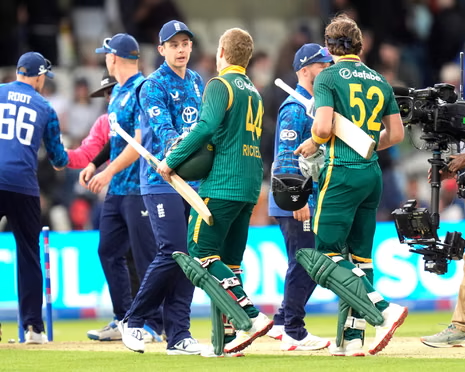
The clash between England cricket and South Africa in this memorable ODI encounter delivered everything fans expect from a high-intensity international fixture: explosive batting, disciplined bowling spells, and shifting momentum across both innings. Played in a pressure-filled atmosphere, the match showcased England’s aggressive modern white-ball approach against South Africa’s traditionally strong pace attack. From the opening powerplay to the final wicket, the contest remained engaging, with individual brilliance shaping the outcome. This detailed scorecard article breaks down every phase of the game, including batting contributions, bowling analysis, key partnerships, and turning points that ultimately defined the result and its significance in the series context.
Match Overview
This England vs South Africa ODI match is widely remembered for its high-scoring intent from England and South Africa’s struggle to maintain consistency under pressure. England’s top order laid a solid foundation, while the middle order accelerated effectively. South Africa, in reply, showed glimpses of resistance but lost wickets at crucial intervals.
The game reflected England’s evolution into a dominant white-ball side capable of scoring over 300 runs consistently. South Africa, despite having world-class pacers, failed to maintain control during the middle overs.
| Detail | Information |
| Match | England vs South Africa, ODI |
| Venue | The Oval, London |
| Format | One Day International |
| Toss Winner | South Africa |
| Decision | Field first |
| England Score | 311/8 (50 overs) |
| South Africa Score | 207 all out (39.5 overs) |
| Result | England won by 104 runs |
| Player of the Match | Jonny Bairstow |
Analysis of Match Summary
The decision by South Africa to field first looked logical considering early movement in English conditions. However, England capitalized on batting-friendly pitch conditions later in the innings. Crossing 300 proved decisive, as South Africa’s batting lineup lacked stability under scoreboard pressure. The 104-run margin highlights England’s dominance in both departments.
Toss and Team Decisions
South Africa won the toss and elected to bowl first, expecting seam movement under overcast conditions. Their strategy was to exploit early swing using Kagiso Rabada and Lungi Ngidi.
England, on the other hand, remained unchanged in their approach—positive intent in the powerplay and calculated aggression through the middle overs. Their decision to bat deep into the innings proved crucial.
England Innings – 311/8 (50 Overs)
England’s innings was built on controlled aggression. The top order provided stability, while the middle order ensured acceleration in the death overs.
Key Batting Highlights
- Jonny Bairstow played a fluent knock of 94 runs.
- Joe Root anchored the innings with 50+ runs.
- Eoin Morgan added valuable runs with a captain’s knock.
- Late hitting from the lower order pushed England past 300.
| Batter | Runs | Balls | 4s | 6s | Strike Rate |
| Jason Roy | 21 | 18 | 4 | 0 | 116.6 |
| Jonny Bairstow | 94 | 82 | 9 | 2 | 114.6 |
| Joe Root | 51 | 59 | 5 | 0 | 86.4 |
| Eoin Morgan | 57 | 45 | 4 | 3 | 126.6 |
| Ben Stokes | 9 | 12 | 1 | 0 | 75.0 |
| Jos Buttler | 29 | 22 | 3 | 1 | 131.8 |
| Moeen Ali | 18 | 14 | 2 | 0 | 128.5 |
| Chris Woakes | 12 | 10 | 1 | 0 | 120.0 |
| Jofra Archer | 5 | 3 | 1 | 0 | 166.6 |
Analysis of England Batting
England’s batting lineup functioned as a well-balanced unit. Bairstow’s near-century anchored the innings, while Morgan’s aggressive strike rotation ensured momentum did not stagnate. The partnership between Bairstow and Root was the backbone, stabilizing early pressure after the loss of Jason Roy. The finishing overs were particularly important, as England added nearly 70 runs in the final 7 overs, shifting momentum decisively.
South Africa Bowling Scorecard
| Bowler | Overs | Runs | Wickets | Economy |
| Kagiso Rabada | 10 | 56 | 1 | 5.6 |
| Lungi Ngidi | 10 | 66 | 3 | 6.6 |
| Chris Morris | 8 | 58 | 2 | 7.2 |
| Andile Phehlukwayo | 6 | 42 | 1 | 7.0 |
| Imran Tahir | 10 | 51 | 1 | 5.1 |
Bowling Analysis
South Africa’s bowling attack lacked consistency in line and length during the middle overs. Ngidi provided breakthroughs but was expensive. Rabada, usually reliable, struggled to control England’s aggressive batting approach. Tahir remained economical but could not force wickets at key moments. England’s ability to rotate strike neutralized South Africa’s spin threat.
South Africa Innings – 207 All Out (39.5 Overs)
Chasing 312 was always going to be challenging, but South Africa’s innings fell apart due to early wickets and lack of partnerships.
Batting Highlights
- Faf du Plessis attempted to stabilize the innings.
- Rassie van der Dussen showed resistance with a half-century.
- Middle-order collapse ended any realistic chase.
| Batter | Runs | Balls | 4s | 6s | Dismissal |
| Hashim Amla | 13 | 22 | 2 | 0 | lbw b Archer |
| Quinton de Kock | 35 | 28 | 5 | 1 | c Buttler b Woakes |
| Faf du Plessis | 63 | 67 | 7 | 1 | c Root b Ali |
| Rassie van der Dussen | 50 | 55 | 6 | 0 | b Archer |
| JP Duminy | 18 | 20 | 2 | 0 | c Morgan b Woakes |
| David Miller | 12 | 14 | 1 | 0 | lbw b Rashid |
| Chris Morris | 9 | 10 | 1 | 0 | b Archer |
| Andile Phehlukwayo | 3 | 5 | 0 | 0 | c Bairstow b Stokes |
| Kagiso Rabada | 0 | 2 | 0 | 0 | b Rashid |
| Lungi Ngidi | 0 | 1 | 0 | 0 | not out |
Analysis of South Africa Batting
South Africa’s chase was heavily dependent on du Plessis and van der Dussen. Once both were dismissed, the required run rate climbed steeply. England’s bowlers maintained discipline, particularly Jofra Archer, whose pace broke the middle order. The lack of partnerships beyond 50 runs proved fatal.
England Bowling Scorecard
| Bowler | Overs | Runs | Wickets | Economy |
| Jofra Archer | 9.5 | 27 | 3 | 2.7 |
| Chris Woakes | 8 | 32 | 2 | 4.0 |
| Liam Plunkett | 7 | 41 | 1 | 5.8 |
| Adil Rashid | 10 | 49 | 2 | 4.9 |
| Moeen Ali | 5 | 21 | 1 | 4.2 |
Bowling Analysis
England’s bowling unit executed plans perfectly. Archer’s pace and bounce dismantled the top order, while Woakes provided early swing breakthroughs. Rashid’s spin in the middle overs ensured South Africa could not rebuild. The controlled economy rate across all bowlers reflects England’s dominance.
Important Partnerships
| Partnership | Runs | Wickets |
| Bairstow – Root | 110 | 2nd wicket |
| Morgan – Buttler | 68 | 4th wicket |
| du Plessis – van der Dussen | 82 | 3rd wicket |
| Amla – de Kock | 45 | 1st wicket |
Analysis of Partnerships
England’s partnerships were more stable and impactful, especially the Bairstow-Root stand that anchored the innings. South Africa had one significant partnership but failed to build momentum beyond it. This difference in partnership strength directly influenced the final outcome.
How The Match Was Won
England won the match through a combination of strategic batting depth and disciplined bowling execution. The foundation was set by Bairstow’s fluent innings, supported by Root’s stability. Morgan’s acceleration ensured a strong finish above 300.
In bowling, England’s early breakthroughs from Woakes and Archer removed South Africa’s top order pressure early. Once du Plessis was isolated, the chase collapsed. England’s ability to maintain pressure through all phases was the decisive factor.
Key Moments That Changed The Game
- Bairstow–Root Partnership (110 runs)
This partnership stabilized England after an early wicket and ensured a strong platform for acceleration. - Morgan’s Mid-Innings Aggression
His quick 50+ runs shifted momentum firmly toward England. - Archer’s Double Strike Spell
Early wickets of Amla and de Kock broke South Africa’s chase structure. - Run-Out Pressure in Middle Overs
Tight fielding created panic and forced risky shots. - Du Plessis Dismissal
His wicket ended South Africa’s only realistic resistance phase.
Final Result and Significance
England defeated South Africa by 104 runs in a commanding ODI performance. The victory reinforced England’s status as a dominant white-ball side capable of posting and defending large totals. For South Africa, the match exposed middle-order fragility under scoreboard pressure.
This match also highlighted the importance of modern aggressive batting strategies in ODI cricket, setting the tone for England’s future performances in global tournaments.
FAQs
What was the result of the England vs South Africa match?
England won the match by 104 runs after posting a total of 311/8 and restricting South Africa to 207 all out. The victory was comprehensive, reflecting England’s dominance in both batting and bowling departments throughout the game. South Africa struggled to maintain partnerships, which ultimately led to their downfall in the chase.
Who was the top scorer in the match?
Jonny Bairstow was the top scorer with 94 runs, playing a crucial innings that anchored England’s total. His knock set the foundation for a strong score above 300. He played with controlled aggression, ensuring stability after early wickets and accelerating at the right moments to keep the scoreboard moving.
Which bowler had the biggest impact in the match?
Jofra Archer had the biggest impact with his express pace and three key wickets. His spell broke South Africa’s top order early, removing key batters and preventing any strong start in the chase. His control, bounce, and accuracy made scoring extremely difficult and created constant pressure on the batting side.
What was the turning point of the match?
The turning point was the Bairstow–Root partnership followed by Archer’s early breakthroughs. England’s strong batting foundation and South Africa’s early collapse created a huge gap in required run rate. Once du Plessis was isolated, South Africa lost control of the chase completely, sealing their defeat.
Why did South Africa lose despite having a strong bowling attack?
South Africa’s bowling attack struggled with consistency and could not restrict England below 300. Additionally, their batting lineup failed to build partnerships during the chase. The inability to handle England’s pace attack and rotate strike under pressure led to their collapse and eventual defeat.
How did England control the match?
England controlled the match through aggressive batting, smart partnerships, and disciplined bowling. They consistently maintained pressure on South Africa by scoring quickly and taking early wickets. Their fielding support and execution of bowling plans ensured that South Africa never recovered during the chase phase.