Table of Contents
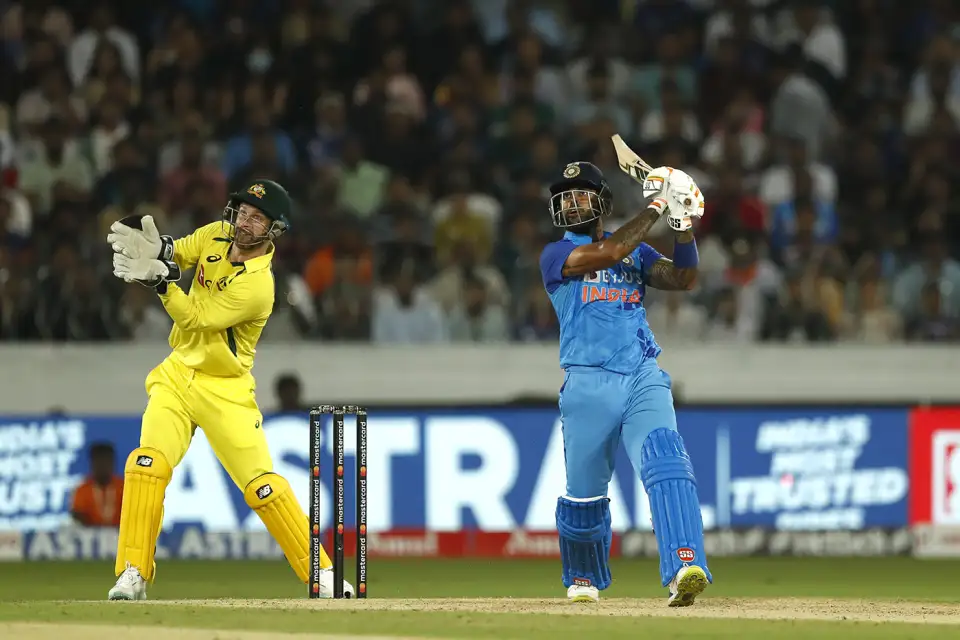
The rivalry between the India National Cricket Team and the Australia Men’s Cricket Team stands as one of the most intense and respected battles in world cricket history. From early one-sided encounters to modern day thrillers, both teams have shaped each other’s evolution across Test, ODI, and T20 formats. Australia’s aggressive pace dominance and India’s technical brilliance and spin strength have created unforgettable moments for fans worldwide. Every series has produced dramatic scorecards, iconic performances, and shifting momentum. This rivalry is not just about wins and losses, but about pride, pressure, and the constant fight for supremacy on the global cricket stage.
Head-to-Head Summary
| Format | Total Matches Played | India Wins | Australia Wins | Draws / No Result |
|---|---|---|---|---|
| Test Matches | 112 | 33 | 48 | 31 |
| One Day Internationals (ODI) | 155 | 59 | 86 | 10 |
| Twenty20 Internationals (T20I) | 37 | 22 | 12 | 3 |
| Total All Formats | 304 | 114 | 146 | 44 |
ICC Men’s Top 10 Team Rankings
| Position | Test Rankings | ODI Rankings | T20I Rankings |
|---|---|---|---|
| 1 | Australia | India | India |
| 2 | South Africa | New Zealand | England |
| 3 | India | Australia | Australia |
| 4 | England | South Africa | New Zealand |
| 5 | New Zealand | Pakistan | South Africa |
| 6 | Sri Lanka | Sri Lanka | Pakistan |
| 7 | Bangladesh | Afghanistan | West Indies |
| 8 | Pakistan | England | Bangladesh |
| 9 | West Indies | Bangladesh | Afghanistan |
| 10 | Zimbabwe | West Indies | Ireland |
Recent Matches
| Date | Match Format | Venue | Winner | Margin / Key Result |
|---|---|---|---|---|
| 06 Nov 2025 | 4th T20I | Carrara Oval, Queensland | India | Won by 48 runs |
| 02 Nov 2025 | 3rd T20I | Bellerive Oval, Hobart | India | Won by 5 wickets |
| 31 Oct 2025 | 2nd T20I | MCG, Melbourne | Australia | Won by 4 wickets |
| 25 Oct 2025 | 3rd ODI | SCG, Sydney | India | Won by 9 wickets |
| 23 Oct 2025 | 2nd ODI | Adelaide Oval, Adelaide | Australia | Won by 2 wickets |
| 19 Oct 2025 | 1st ODI | Perth Stadium, Perth | Australia | Won by 7 wickets (DLS) |
| 05 Jan 2025 | 5th Test | SCG, Sydney | Australia | Won by 6 wickets |
Most Memorable Matches
| Match & Year | Format | Venue | Why It Is Memorable |
|---|---|---|---|
| Kolkata Test (2001) | Test | Eden Gardens, Kolkata | India won after following-on, breaking Australia’s 16-match winning streak behind VVS Laxman’s legendary 281. |
| Gabba Test (2021) | Test | The Gabba, Brisbane | India chased down 328 on the final day with a depleted squad, sealing a historic 2-1 Border-Gavaskar Trophy win. |
| World Cup Final (2023) | ODI | Ahmedabad | Australia stunned an undefeated Indian side at home by 6 wickets to lift their 6th ODI World Cup title. |
| Champions Trophy Semi (2025) | ODI | Dubai | India avenged previous global tournament losses by defeating Australia by 4 wickets to progress to the final. |
Player Analysis Table
| Player Name | Team | Role | Impact & Key Records Against Rival |
|---|---|---|---|
| Virat Kohli | India | Top-order Batter | Averages over 52 in Test cricket against Australia, executing historic centuries across Adelaide, Melbourne, and Perth. |
| Travis Head | Australia | Opening / Attacking Batter | India’s primary nemesis in major finals, tracking a century in the 2023 WTC Final and the 2023 ODI World Cup Final. |
| Jasprit Bumrah | India | Fast Bowler | Masterful across conditions; led India to historic test wins in Australia with lethal spells at Melbourne and Perth. |
| Steven Smith | Australia | Top-order Batter | Exceptionally dominant against Indian spin and pace alike, averaging over 52.8 in Test matchups. |
| Rohit Sharma | India | Opening Batter / Captain | Holds a masterful white-ball tracking against Australia, including multiple ODI double-centuries and anchoring recent 2025 ODI wins. |
| Pat Cummins | Australia | Fast Bowler / Captain | Highly effective at utilizing hard Australian decks to bounce out top-order batters, spearheading multiple ICC trophy wins over India. |
The Origins of a Fierce Cricket Rivalry
The rivalry between the India National Cricket Team and the Australia Men’s Cricket Team began as a classic contrast of styles and cricketing philosophy. Australia entered international cricket as a dominant force built on pace, discipline, and an aggressive winning mindset. India, on the other hand, was still developing its identity in world cricket, relying heavily on technical batting and spin variations. Early matches were less about rivalry and more about learning experiences for India, as Australia frequently controlled sessions with superior fast bowling and sharper fielding standards. However, even in those early encounters, sparks of competitiveness appeared. Indian players slowly adapted to Australian intensity, setting the foundation for what would eventually become one of the most emotionally charged rivalries in modern cricket history.
| Score | Winning | Performance | Season | Other useful info |
|---|---|---|---|---|
| 1-0 | Australia dominant | Australia strong pace attack | Early era | First encounters |
| 2-0 | Australia lead | India learning phase | 1980s | Skill gap visible |
| 3-1 | Australia ahead | India improving batting | 1990s | Rising competitiveness |
| 2-1 | Balanced start | India emerging talent | Late 1990s | First resistance |
Early Clashes and Australia’s Dominance
In the early phase of encounters between India and Australia, the Australian side consistently dictated terms with ruthless efficiency. Their fast bowlers exploited bounce and movement, making life difficult for Indian batters unfamiliar with such sustained aggression. India struggled to build long partnerships, often collapsing under scoreboard pressure. Australia’s batting lineup capitalized on every mistake, posting commanding totals that shifted momentum early in matches. Despite the dominance, these clashes were crucial learning chapters for India, exposing gaps in technique and temperament. Gradually, Indian bowlers began to find rhythm, especially spinners who exploited subcontinent conditions. These early defeats, though one-sided, played a vital role in shaping India’s future resilience against Australia’s disciplined and aggressive brand of cricket.
| Score | Winning | Performance | Season | Other useful info |
|---|---|---|---|---|
| 3-0 | Australia dominant | Fast bowling control | 1980s | India batting struggle |
| 4-1 | Australia ahead | Strong top order | Early 1990s | Fielding advantage |
| 2-0 | Australia lead | Spin challenge for India | Mid 1990s | Tactical superiority |
| 3-1 | Australia control | Consistent performances | Late 1990s | Momentum dominance |
India’s Breakthrough Moments
India’s breakthrough against Australia did not arrive overnight; it was built through persistence and belief. The turning point came when young Indian batters began standing up to Australia’s pace attack with confidence. Players started rotating strike better, reducing pressure, and building partnerships under challenging conditions. Bowlers also played a crucial role by attacking more aggressively rather than defensively. These improvements led to landmark victories that shifted psychological balance. Australia was no longer unbeatable, especially in subcontinent conditions where India’s spin attack became highly effective. These wins were symbolic, signaling India’s arrival as a competitive force capable of challenging Australia in both home and away conditions.
| Score | Winning | Performance | Season | Other useful info |
|---|---|---|---|---|
| 1-0 | India breakthrough | Spin dominance | Early 2000s | Confidence rise |
| 2-1 | India edge | Improved batting depth | 2001 series | Historic wins |
| 3-2 | Balanced rivalry | Tactical improvement | Mid 2000s | Close contests |
| 2-0 | India home wins | Strong spin attack | 2000s | Turning point era |
The Ganguly Era Shift
The arrival of the Ganguly era marked a major psychological shift in the rivalry between India and Australia. Under leadership that encouraged aggression and self-belief, India stopped playing defensively against Australia. Instead, they matched fire with fire. The famous series battles of this era showcased fearless batting, strategic declarations, and sharper field placements. Australia still remained a strong side, but India was no longer intimidated. This era produced several iconic matches where momentum swung rapidly, and individual brilliance defined outcomes. The rivalry became emotionally charged, with both teams refusing to give an inch, making every match feel like a final.
| Score | Winning | Performance | Season | Other useful info |
|---|---|---|---|---|
| 2-1 | India strong fight | Aggressive mindset | Early 2000s | Leadership impact |
| 1-1 | Even contest | Balanced performances | 2003-2004 | ICC events |
| 2-0 | Australia reply | Tactical dominance | Mid 2000s | Rivalry heat |
| 1-2 | India competitive | Fearless cricket | Late Ganguly era | Turning mindset |
Modern Era Superstars and High-Intensity Battles
The modern era of India vs Australia cricket has been defined by superstars and near-equal competition across formats. Players like Virat Kohli, Rohit Sharma, Steve Smith, and Pat Cummins have elevated the rivalry to world-class intensity. Matches are now decided by small moments rather than long dominance. India’s batting depth and Australia’s pace attack create a perfect balance of strengths. Fielding standards, analytics, and fitness levels have also dramatically improved both sides. Every series feels unpredictable, with momentum shifting within sessions. This era has produced thrilling finishes, record chases, and unforgettable Test matches that have added new chapters to the rivalry’s legacy.
| Score | Winning | Performance | Season | Other useful info |
|---|---|---|---|---|
| 2-2 | Even rivalry | Star performances | 2010s | Balanced contests |
| 3-2 | India edge | Strong batting chase | 2018-2020 | Kohli era peak |
| 2-1 | Australia fight | Bowling dominance | 2020s | Cummins impact |
| 1-1 | Balanced series | High intensity | Recent years | Modern rivalry peak |
Conclusion
The journey of matches between the India National Cricket Team and the Australia Men’s Cricket Team reflects the true spirit of competitive cricket. What began as a dominance story has transformed into a balanced rivalry filled with iconic scorecards, legendary performances, and unforgettable turning points. Both sides have produced world class cricketers who have pushed each other to new heights. Whether in ICC tournaments or bilateral series, every clash carries emotional weight and tactical depth. Today, this rivalry continues to define modern cricket, offering fans unpredictable results, fierce competition, and moments that will remain etched in cricket history for generations.
FAQs
What makes India vs Australia cricket rivalry so special?
The rivalry is special due to contrasting styles, intense competitiveness, and world-class players on both sides. Every match is high-pressure, featuring dramatic scorecards, shifting momentum, and iconic moments that define modern international cricket history across all formats consistently.
Which team has historically dominated India vs Australia matches?
Australia dominated early encounters with strong pace bowling and discipline. However, in recent decades, India has matched them closely, especially at home and in ICC events, making the rivalry far more balanced and unpredictable in modern cricket.
Who are the key players in this rivalry?
Key players include Virat Kohli, Rohit Sharma, Sachin Tendulkar, Steve Smith, Ricky Ponting, and Pat Cummins. These stars have delivered match-winning performances, shaping scorecards and creating unforgettable moments in both Test and limited-overs cricket formats.
What are the most memorable matches between India and Australia?
Memorable matches include World Cup clashes, Border-Gavaskar Trophy Tests, and high-scoring ODIs. These games often feature dramatic collapses, record partnerships, and last-over finishes that have thrilled fans and defined cricketing rivalry history globally.
Why is the Border-Gavaskar Trophy important?
The Border-Gavaskar Trophy symbolizes Test supremacy between India and Australia. It represents pride, strategy, and endurance, often producing intense battles, legendary performances, and historic scorecards that shape the legacy of both cricketing nations over time.